Ask a UK florist where their flowers come from and, more often than not these days, part of the answer is a farm a few counties away rather than a wholesaler in the Netherlands. New figures released ahead of British Flowers Week 2026 show the British-grown cut flower sector isn’t just a nice-to-have for eco-conscious shoppers anymore — it’s a genuinely growing part of the UK flower trade, with the numbers to prove it.
Flowers from the Farm, the grower network that now runs British Flowers Week (the event moved to their stewardship after years under New Covent Garden Flower Market), reports that its members — over 1,000 independent growers across the UK — saw average business revenues climb to £33,600 in 2025, up 12% year-on-year. Yields per hectare rose from 30,700 to 43,500 stems, and the average grower’s own output was up 55% to 32,500 stems. Olivia Wilson, the organisation’s Policy Lead, called it “a landmark year for the British grown flower movement,” adding that “the data confirms what we see on the ground: a professionalising industry that is growing in both economic value and environmental ambition.”
What’s driving the shift
Most cut flowers sold in the UK are still imported — typically flown or trucked in from the Netherlands, Kenya and Colombia — because year-round demand for out-of-season blooms has to come from somewhere. But a local florist stocking British-grown stems alongside the imported staples is no longer unusual, and for a simple reason: seasonal, home-grown flowers travel less, last well when they’re properly conditioned, and increasingly come with a story customers are happy to pay for — the named farm, the county, sometimes the grower themselves.
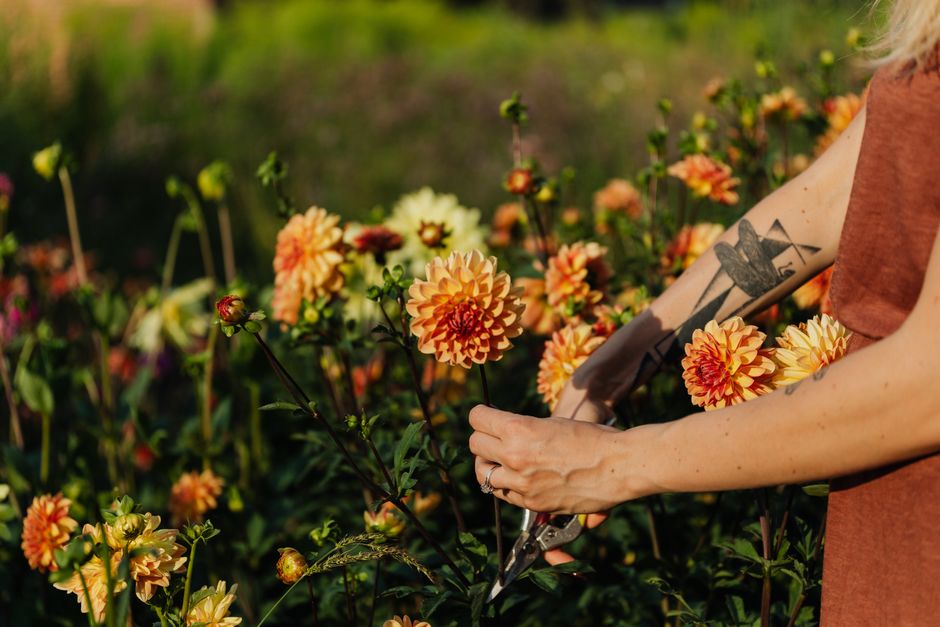
Dahlias, sweet peas, cornflowers and British-grown garden roses are the stems most likely to carry that story well, since they’re at their best exactly when UK growing conditions suit them. A bouquet built around what’s actually in season locally, rather than a fixed catalogue photo, is often the easiest way for a florist to work British stems in without inflating the price.
What it means if you’re ordering flowers
For customers, the practical upshot is worth knowing before you call round: British-grown flowers aren’t automatically pricier, but they are more seasonal, so a florist offering them may steer you toward what’s actually cutting well that week rather than a fixed list. If you’re arranging flowers for delivery in Aberdeen, ordering from a florist in Aberdare, or based anywhere in between — right through to Newcastle upon Tyne — it’s a fair question to ask when you book: “do you have anything British-grown in at the moment?” A good independent florist will usually know exactly what’s come in that week and from where.
It’s also worth booking earlier than you think you need to for anything tied to a specific date — a wedding, an anniversary, a funeral — since a florist working seasonal, British stems is planning around what a grower can actually cut that week, not pulling from an always-available import list.
A trade that’s growing, not just greener
The 2026 British Flowers Week programme, running 15–21 June and timed to coincide with the United Nations’ International Year of the Woman Farmer, reflects how much the grower side of the industry has organised itself in a short space of time: nationwide events across England, Scotland, Wales and Northern Ireland, a partnership with London’s Garden Museum, and demonstrations like Castle Farm in Kent hand-cutting more than 10,000 lavender bunches a week at peak season. None of that changes what’s on offer at your nearest flower shop overnight, but it’s a good sign for anyone who’d rather their bouquet came from a farm than a flight.